
Author – Awadhesh Sharma
Draupadi is one of the principal characters of the Mahabharat, the sacred text composed by the legendary poet Ved Vyas. Draupadi is believed to be a partial incarnation of goddess Lakshmi. She appeared on the earth to assist divine forces to destroy the demons that had become kings and fighters during the age of Dwapar. Her father was Drupad, the king of Panchal. Her husbands were the five Pandava brothers, Yudhishthir, Bhim, Arjun, Nakul and Sahadev.
Guru Dronacharya had humiliated Drupad and appropriated half of his kingdom by force. Drupad never reconciled with the disgrace and was determined to avenge the Guru. Realising himself incapable to retaliate, he longed for a son who could kill Dronacharya. For getting divine support, he searched for a seer who could perform the sacred ritual that would enable him to obtain such a son.
Drupad found the seer named Yaj who agreed to perform the Putrayeshti or son-giving sacrifice. Yaj started the rite with the king and asked him to make the queen available to join at the chosen time. When the time approached, the queen was still not ready. Yaj did not wait for her, as the auspicious time was about to elapse. He offered the oblation to the sacrificial fire with specific Mantras before the queen arrived. Two fully-grown persons, a male and a female appeared from the fire pit. Both accepted the king and the queen as their parents.
The male was named Dhrishtadhyumna, who later became Commander in Chief of the Pandavas’ army. The female was named Draupadi. She was also known by other names including Krishna that referred to her dark complexion and Panchali referring to her status as the princess of Panchal.
King Drupad arranged Svayamvar for Draupadi to choose a suitable husband. Kings and princes from all over India were invited to attend. To test the suitability of the candidates he had set a condition that required the highest level of skill in archery. Aspiring candidates were expected to fix the string of the bow and hit the arrow into the eye of a fish replica, which was spinning at a certain height over a tank filled with water. They were to aim at the eye by looking on the reflection of the revolving fish on water in the tank.
Pandava brothers, with mother Kunti, had escaped safely from the Lakshagrih, the house of wax, which was devised by the Kauravas to burn them. They lived in disguise of Brahmins and survived on alms. During the period of Svayamvar, they lived in the Panchal kingdom. They joined a group of Brahmins and attended the Svayamvar in expectation of getting generous gifts.
During the main event, Draupadi was standing with a garland to honour the winning candidate. Kshatriya kings and princes tried to lift the bow, but none succeeded. Then Karna, the king of Anga tried. He lifted the bow and succeeded in stringing the bow. At that moment Draupadi interrupted and objected to Karna’s eligibility. She was unwilling to consider Karna as a potential husband due to his ancestry. It was believed that he was a son of charioteer. Karna grudgingly abandoned his attempt.
Wishful Kshatriyas could not meet the condition of Svayamvar. Arjun in disguise of a Brahmin appeared at the scene and sought permission from Drupad to try. Drupad consented. Arjun lifted the bow, tied the string and with an arrow hit the target in his first attempt. Draupadi accepted Arjun as her husband and garlanded him. Kshatriya kings and princes objected to a Brahmin’s victory but were overpowered by Arjun and Bhim.
Pandava brothers brought Draupadi to their residence. Kunti was inside the house busy with domestic chores. They wanted to surprise their mother. Arjun said, ‘Mother, see what alms we have brought today”. She responded without looking at the alms and told them to distribute equally among all the five brothers. Draupadi and Pandavas were shocked. In the meantime, Kunti came out and saw the beautiful lady with her sons. She learnt that her sons had called Draupadi alms.
Sharing a woman among five brothers was against the social norms. The words of mother Kunti could not be overruled. As the family was deliberating, lord Krishna arrived at Pandavas’ residence and spoke about the inevitability of Draupadi having five husbands. He told them the story of Draupadi’s previous life.
In the previous life she had worshipped lord Shiva for a suitable husband. When Shiva appeared to bless her, she asked for a husband five times with five specific attributes. Shiva told her that the attributes she had asked could not be found in a single person. In her next life, she would get five husbands, each with the requested quality.
Ultimately, Draupadi was married to all five Pandava brothers.
Seers and wellwishers of Pandavas advised them to make rules about managing the relationship with their common wife. It was agreed that if one husband was with Draupadi, others should not enter her chamber. If anyone entered, he would go to exile for twelve years. To allow for having progeny, she would spend one year with each husband in turn. These conditions served them well. Draupadi became the mother of five children, one with each husband.
Once, Arjun inadvertently entered Draupadi’s chamber when she was with Yudhishthir. As per the agreed terms, Arjun went into exile, and obtained various weapons and charms that helped them in later events of their life.
After marriage, Draupadi along with Pandavas and Kunti came to Hastinapur, capital of the Kuru kingdom. She was welcomed as a daughter-in-law with respect. In order to minimise discord between Pandavas and Kauravas, the kingdom was divided. Pandavas were given Khandavaprasth, a forested wasteland as their share of the kingdom. They converted the wasteland into a prosperous kingdom with their capital called Indraprasth.
Yudhishthir became an emperor and performed a Rajsuya Yagya, royal consecration. Kings, princes and honourable leaders including Krishna, Shishupal, Duryodhan and elders of the Kuru dynasty participated in the event. Following an argument over selection of the first recipient of honour at the consecration, Krishna killed Shishupal through his Sudarshan Chakra. His finger was hurt and started bleeding. Draupadi tore out a piece of fabric from her sari and bandaged Krishna’s injured finger.
Duryodhan was awed by the opulence and splendour of Pandavas’ achievements. Renowned architect Maya, master of illusion, had built their palaces. While exploring various sections of the buildings, Duryodhan became mesmerised. During a stroll through a hall, he mistook solid surface to water filled pond and lifted his garments to avoid them wetting. On another occasion, he stepped in water filled pond assuming it to be dry surface and fell into it. Draupadi observed his movements and was amused. She laughed and pointing at him commented, “The son of a blind man is blind”. Duryodhan felt ashamed, became infuriated and left the site bitterly.
Soon after the events at royal consecration, Kauravas invited Pandavas to a game of dice. Yudhishthir could not resist the invitation for gambling. Pandavas along with Draupadi went to Hastinapur. The game was arranged in the royal court and all major elders of the kingdom were in attendance.
Shakuni, the maternal uncle of Kauravas was an expert in the game of dice. He played on behalf of Duryodhan. Yudhishthir played from the Pandavas’ side. Yudhishthir started losing the game from the beginning, and as the gambling continued, he lost everything including his kingdom, brothers and himself. Finally he wagered Draupadi. Shakuni won the wager for Duryodhan, who declared all the Pandavas and Draupadi as his slaves. He intended to humiliate Draupadi for her earlier insult. Karna, a friend of Duryodhan, also found an opportunity to take revenge of her comment during the Svayamvar, and spoke contemptibly about Draupadi.
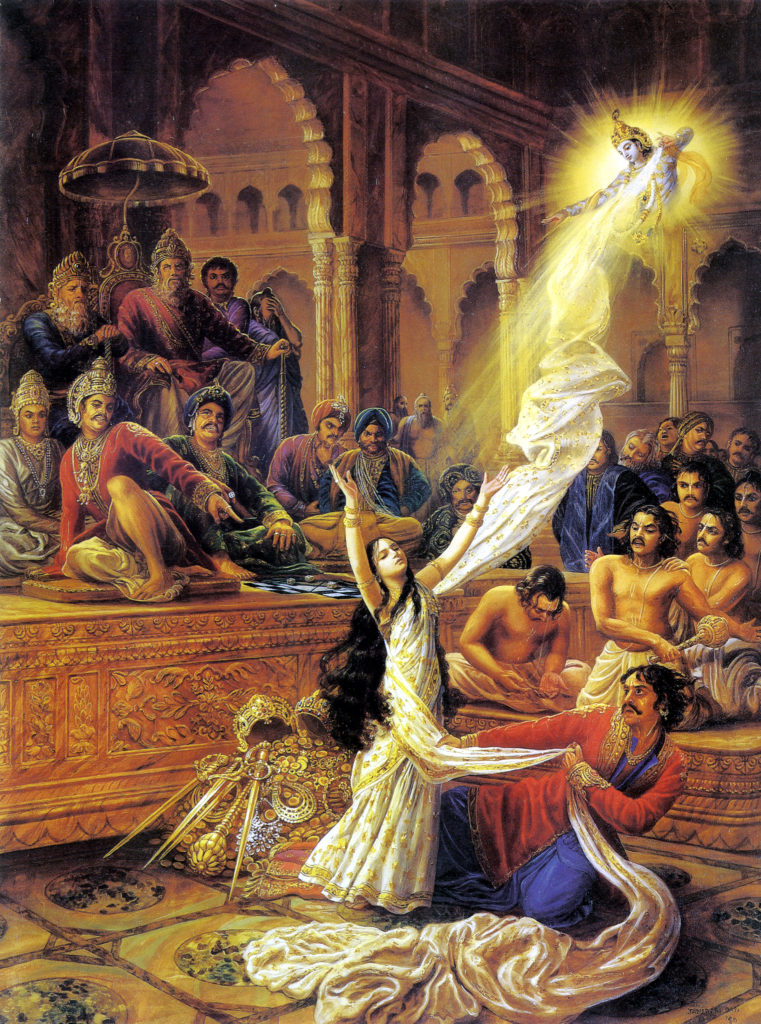
Duryodhan ordered a guard to bring Draupadi to the gambling hall. Draupadi was in period and refused to go outside her chamber. Then Duryodhan sent his brother Duhshasan to bring her forcibly. He dragged Draupadi to the hall by grabbing her hair.
Draupadi questioned the whole assembly including king Dhritrastra, Bhishma, Dronacharya and others about the righteousness of Yudhishthir wagering her. No one answered to her satisfaction. Then Duryodhan instructed Duhshasan to disrobe Draupadi in the middle of the assembly. Duhshasan complied and started removing her sari. She entreated for help but no one came forward to succour. Draupadi remembered Krishna and begged for his mercy. Krishna with his divine action supplied an immeasurable length of cloth. Duhshasan could not undress her.
Ill omens started appearing. Draupadi vowed not to tie her hair until she had washed it with the blood of Duhshasan. Dhritrastra became scared of Draupadi’s divine power and restored all that Pandavas had lost during the gambling.
On Duryodhan’s instigation, a second gambling contest was arranged. Pandavas lost and according to the terms of the contest, they were exiled for thirteen years. The last year of the exile was to be spent incognito. If they were revealed during the final year, then they had to spend another twelve years in exile. Draupadi accompanied the Pandavas during their banishment.
During the exile, sage Durvasa, well known for his short temper, visited Pandavas after mealtime. As customary, Yudhishthir invited him for a meal. Durvasa accepted and promised to return after taking a bath. Draupadi who usually ate last had eaten her meal and washed the Akshay Patra.
The Akshay Patra had the power to supply unlimited food, as long as it was not washed. Draupadi faced a dilemma of feeding Durvasa. She remembered Krishna who immediately appeared and asked for food. She brought the Akshay Patra to show her inability to feed anyone. Krishna noticed a particle of grain in the Patra. He ate it and expressed satisfaction. Durvasa was on the way to Pandavas’ cottage. Immediately, he felt his hunger satisfied and went away without troubling the Pandavas.
Once Pandavas were out collecting food in the forest. Jayadrath, the king of Sindhu and husband of Duryodhan’s sister passed by their cottage. He saw Draupadi alone in her lodge and became infatuated. He caught her by force and carried her away in his chariot. In the meantime Pandavas returned and noticed Draupadi missing. They started a search and eventually captured Jayadrath. Draupadi was recovered and as punishment for his crime, they shaved Jayadrath’s head, leaving five tufts of hair on his head.
In the thirteenth year, Draupadi stayed at the kingdom of Matsya in disguise like her husbands. She became Shairendhri or hairdresser of queen Sudeshana. The queen’s brother named Kichak was the army commander of the kingdom. He became obsessed with Draupadi. She tried to protect herself from his harassment without any success. Finally, she approached Bhim who was living there in disguise of a chef. Using schemes, Draupadi managed to kill Kichak with the help of Bhim.
After the end of their exile, Pandavas demanded return of their kingdom. A war between Kauravas and Pandavas became foreseeable. Pandavas were willing to compromise but Draupadi demanded revenge from Kauravas. Finally Kurukshetra war started, and continued for eighteen days. Duhshasan, along with other Kauravas was killed. Bhim brought the blood of Duhshasan to Draupadi. Draupadi completed her vow of washing her hair with Duhshasan’s blood before tying her hair.
On the night of the last day of the war, Ashwathama, the son Dronacharya, killed all five sons of Draupadi. Ashwathama was captured and punished by the Pandavas.
After their victory, Pandavas regained control of their ancestral kingdom of Kuru dynasty. Yudhishthir became the king and Draupadi the queen.
Draupadi and Yudhishthir performed the Ashvamedh Yagya and ruled for thirty-six years. Soon after Krishna left his mortal body, Pandavas decided to renounce the world and travelled towards the Himalaya in the direction of heaven. On the way, it was Draupadi who first collapsed. Bhim asked Yudhishthir about the reason for her demise. Yudhishthir responded that it was due to her strong partiality for Arjun.
Draupadi represents the fiery temperament consistent with the source of her origin. She experienced cruel treatments and was able to overcome her circumstances with intelligence and resilience.