
Author – Awadhesh Sharma
Maharani Ahilyabai was the ruler of Malwa kingdom in India from 1767 to 1795. She was a great builder and a patron of religious and welfare institutions. She built temples, dharmashalas, rest-houses, ghats or the flights of steps at riverbanks, wells, ponds and other infrastructure for the welfare of her subjects. She ruled her kingdom with compassion, love and fairness.
Ahilya was born in the village named Chaundi in the present day Ahmadnagar district of Maharastra on 31 May 1725. Her father’s name was Mankoji Shinde, who was a village chief. Her mother was Sushila Shinde. They belonged to the community, which was mostly engaged in farming and sheep rearing trades.
In the early eighteenth century, Maratha forces had expanded their control over a large part of India. In the Maratha administrative structure, Peshwas or Prime Ministers held a very powerful position and in reality, they were the real rulers of the Maratha domain.
Peshwa Baji Rao I ruled from his headquarters at Pune on behalf of Chhatrapati Shahuji, the Maratha king, who was based in Satara. The Subedar or head of a province reported to him. Subedars were responsible for administration of provinces.
Baji Rao I had appointed Malhar Rao Holkar the chief general of the Malwa region, which now constitutes parts of modern Madhya Pradesh and Rajasthan. Malhar Rao eventually became a Subedar. He was the first Maratha ruler of Malwa. Indore was the capital of the region. Indore is the distorted form of Indrapur, the ancient name of the place.
Malhar Rao had a number of wives but had only one son named Khande Rao from his first wife Gautamabai. He loved his son immensely and was conscious of his weaknesses. Khande Rao was not interested in the state’s affairs, and his temperament was not encouraging for an effective future ruler.
Malhar Rao was on a journey to Pune to see Baji Rao I in 1933. On the way he stopped at village Chaundi. As per the prevailing practice, he stayed at the village chief Mankoji’s house. There, he saw Ahilya, the eight-year-old daughter of Mankoji. He noticed her strength, courage and compassion towards fellow human beings and animals alike.
He learnt about incidents involving her actions. In one instance, the temple priest of the village had barred girls from worshipping at the Shiv temple. She built her own Shivling for girls where they could worship without restrictions. In another incident, she freed a cow, which was separated from her calf and held in a temple’s enclosure. A third incident related to her friend who became a widow soon after her marriage. The practice of child marriage was common during that period. Widows were ostracised from the community. Ahilya objected to this practice and tried her best to help her widow friend.
Malhar Rao realised that the girl demonstrated traits uncommon in a village girl of her age. Appropriate trainings would help her abilities to flourish and would make her a fitting companion for his son. Her attributes would hopefully help him become a worthy ruler.
He approached her parents with a request to allow Ahilya marry his son Khande Rao. Ahilya’s parents agreed and soon the wedding was solemnised in the village. Malhar Rao renamed her Ahilyabai Holkar. After the wedding Ahilyabai came to Indore and started living in the palace.
Ahilyabai was unaccustomed to the palace etiquette. Everything was new to her. She missed her parents, pet animals and friends. Khande Rao was two years older than her. His attitude towards his wife was unfriendly in the beginning.
Malhar Rao had full faith in Ahilyabai’s potential and instructed her chief queen Gautamabai to teach the girl palace customs and other skills that queens required. Gautamabai and another sympathetic queen Harkubai helped Ahilyabai to learn palace practices and to read and write. Ahilyabai also learnt politics, handling of arms and art, culture and religion.
Ahilyabai became familiar with governance and politics as well as with domestic responsibilities. Malhar Rao permitted her to attend and witness court proceedings. She was trained to become helpful in state administration. Her counsel to her husband and even to her father-in-law proved to be beneficial at times.
She gave birth to a son Male Rao in 1745 and a daughter Muktabai in 1748.
In 1754, the Maratha forces laid siege upon the Kumbher Fort, which was under control of Maharaja Surajmal. Khande Rao was inspecting his troops in the open battlefield where he was struck by a cannon ball from the enemy’s army and killed instantaneously.
Ahilyabai decided to commit Sati, a Hindu tradition of voluntarily burning of a widow on the funeral pyre of her husband. Malhar Rao prevented her from committing Sati. In those times, it was wrongly thought that a woman’s life had no value in society, if she did not have a man to take care of her. The practice of Sati is now banned in India.
In 1761, the Maratha army was defeated in the Third Battle of Panipat. Malhar Rao survived the battle but felt greatly humiliated. He died in 1766. After his death, Malhar Rao’s grandson and Khande Rao’s only son Male Rao became the ruler of Malwa, under the regentship of Ahilyabai. Male Rao was mentally unwell and died of his illness in 1767.
The deaths of her husband, father-in-law and son in succession devastated Ahilyabai. She was the only person from the Holkar family trained to take over control of administration of the province. She accepted her responsibility to protect and serve her subjects. Ahilyabai appointed her loyal defense aide, Tukoji Holkar, as the chief of army.
Some in Malwa objected to her rule in the province. Their leader conspired with Raghoba Dada of Pune and invited him to take over the reign of Malwa. Raghoba was the uncle of Madhav Rao Peshwa, the fourth Peshwa of Maratha Empire. He aspired to become a ruler.
Raghoba planned to challenge Ahilyabai and take over rule of the province. Ahilyabai’s spies kept her well informed. As Raghoba marched on towards Malwa, Ahilyabai sent him a message, “Fighting you would not affect me as much as it would affect your prestige if you lose to a woman.”
Ahilyabai also wrote to Madhav Rao seeking permission to look after the administration herself. She sent letters to other Maratha nobles requesting their support and help of their armies. The army of Malwa supported her leadership.
Raghoba reached Ujjain. Ahilyabai set out to meet him. She headed a procession of her entire army, elephants and horses. As she set out on her epic journey, people came out in her support and veneration, to see their queen in all her strength and glory. This expression of love, respect, admiration and loyalty by the common people was acknowledged in Pune.
In December 1767, Madhav Rao Peshwa instructed Raghoba to return and granted permission to Ahilyabai to continue the administration of Malwa. She moved her capital from Indore to Maheshwar, by the banks of the river Narmada. Maheshwar is the modern name of the ancient town of Mahishmati.
The town had been associated with ancient legends relating to Ravan, Arjun Kartyavirya and Parasuram. Here, on the banks of Narmada, Kartyavirya captured Ravan when the later challenged him to a combat. Ravan was released only after Parasuram killed Kartyavirya.
At the start of her reign, the province of Malwa was not at peace due to the activities of anarchists in its remote regions. Ahilyabai decided to suppress these illegal activities and declared a competition for subduing evil forces in her kingdom. A brave man of ordinary origin Yashwant Rao succeeded in accomplishing her mission. Ahilyabai gave her daughter Muktabai in marriage to Yashwant Rao.
Muktabai had a son from Yashwant Rao named Nathoba for whom Ahilyabai had deep love and whom she considered as her heir. However, Nathoba died of consumption in 1790 and about a year later Yashwant Rao passed away.
Muktabai decided to immolate herself with the dead body of Yashwant Rao. Ahilyabai tried to dissuade her daughter from taking this recourse but Muktabai remained firm in her resolve and committed Sati. This event caused Ahilyabai immense personal grief.
In her role as queen, Ahilyabai ruled Malwa in an enlightened manner. She reinstated those who had opposed her. Ahilyabai held court every day. She met the public daily and was accessible to anyone who wished to speak to her.
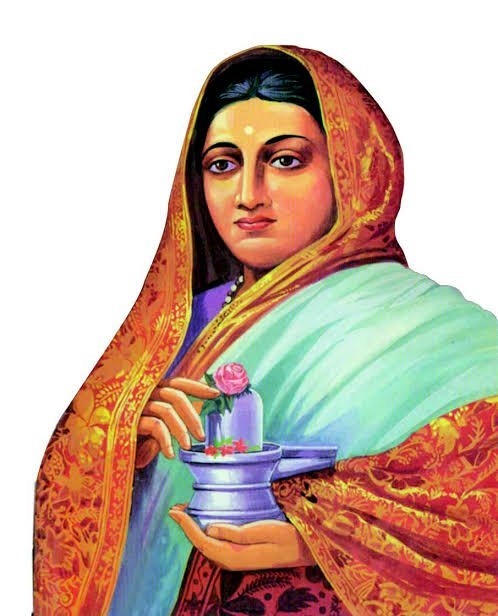
She was religious from her childhood and used to pray at home and temples. Khandowa, a form of Shiv, was her ancestral deity. Shivling was the revered deity of the Holkar family. While dispensing justice, she held a Shivling in her hand, considering that lord Shiv would guide her to the correct judgement.
Ahilyabai was one of the wealthiest rulers in the Maratha Empire. She did not use the kingdom’s riches for her personal pleasures. Rather than residing in a palace, she lived in a humble two-story house.
Ahilyabai was able to grant rights, which even today women struggle for. She abolished laws that forbade widows from owning property and adopting children.
Among Ahilyabai’s accomplishments was the development of Indore from a small village to a prosperous and beautiful city. She built, temples, forts and roads in Malwa, sponsored festivals and donated to welfare and religious institutions.
During her time, trade grew, and farmers were happy. Art, music and literature blossomed in the province. Maheshwar became a place of literary, musical, artistic and industrial enterprise. She entertained famous Marathi poets from Maharashtra, and patronised Sanskrit scholars. Craftsmen, sculptors and artists received salaries and honours at her capital. It was indeed an ideal kingdom.
Weavers settled and developed their skills in Maheshwar because of Ahilyabai’s encouragement. She set up a textile mill there. So fine were the Maheshwari weaves that the prosperous officers in the Peshwa courts used to order them to Pune. In current times, Maheshwar continues to be known for its fine cotton and silk cloth, and Maheshwari Sarees.
Outside Malwa, Ahilyabai built dozens of temples, ghats, wells, tanks and rest-houses across an area stretching from the Himalayas to pilgrimage centres in South India.
Among the temples, which Ahilyabai built in all parts of India, two were particularly significant. Their reconstruction gave immense pleasure and satisfaction to millions of Hindus. About a century ago, Somnath and Kashi Vishwanath temples were razed to the ground on a Mughal Emperor’s orders. Both Somnath and Kashi Vishwanath temples housed two of the twelve Jyotirlings of Shiv. Ahilyabai rebuilt both temples near the original sites.
Ahilyabai built Vishnupad Temple at Gaya, a sacred site for offering Tarpan, oblations to ancestors.
Temples and religious institutions in Ayodhya, Mathura, Haridwar, Kanchi, Avanti, Dwarka, Badrinath, Rameshwar and Jagannath Puri and other places received regular charity from Ahilyabai.
She was conscious of dangers posed by activities of European trading companies and advised rulers to be careful of their interference in Indian domestic affairs.
Ahilyabai died on 13 August 1795 at the age of 70. Ahilyabai’s rule is remembered as a golden age in Malwa’s history. After her death, her commander-in-chief and nephew Tukoji Rao Holkar succeeded her. He soon abdicated the throne in favour of his son Kashi Rao Holkar in 1797.
Ahilyabai is venerated as Devi, deity and is addressed by terms Rajmata, Maharani and Punyashlok. Historians have noted how she encouraged all within her kingdom’s boundaries to succeed in their endeavours.
Annie Besant, a British theosophist and ardent proponent of Indian self rule, wrote about Ahilyabai, “Far and wide the roads were planted with shady trees, and wells were made, and rest-houses for travellers. The poor, the homeless, the orphaned were all helped according to their needs. The Bhils, who had long been the torment of all caravans, were routed from their mountain hideouts and persuaded to settle down as honest farmers. Hindu and Muslim alike revered the famous Queen and prayed for her long life.”
A commemorative stamp was issued in her honour in 1996 by the Indian government. As a tribute to the ruler, Indore’s domestic airport has been named Devi Ahilyabai Holkar Airport. The Indore University too was renamed Devi Ahilya Vishwavidyalaya.
Numerous books have been written and films produced about her life. A TV serial entitled Punyashlok Ahilyabai Holkar has become very popular among viewers.